
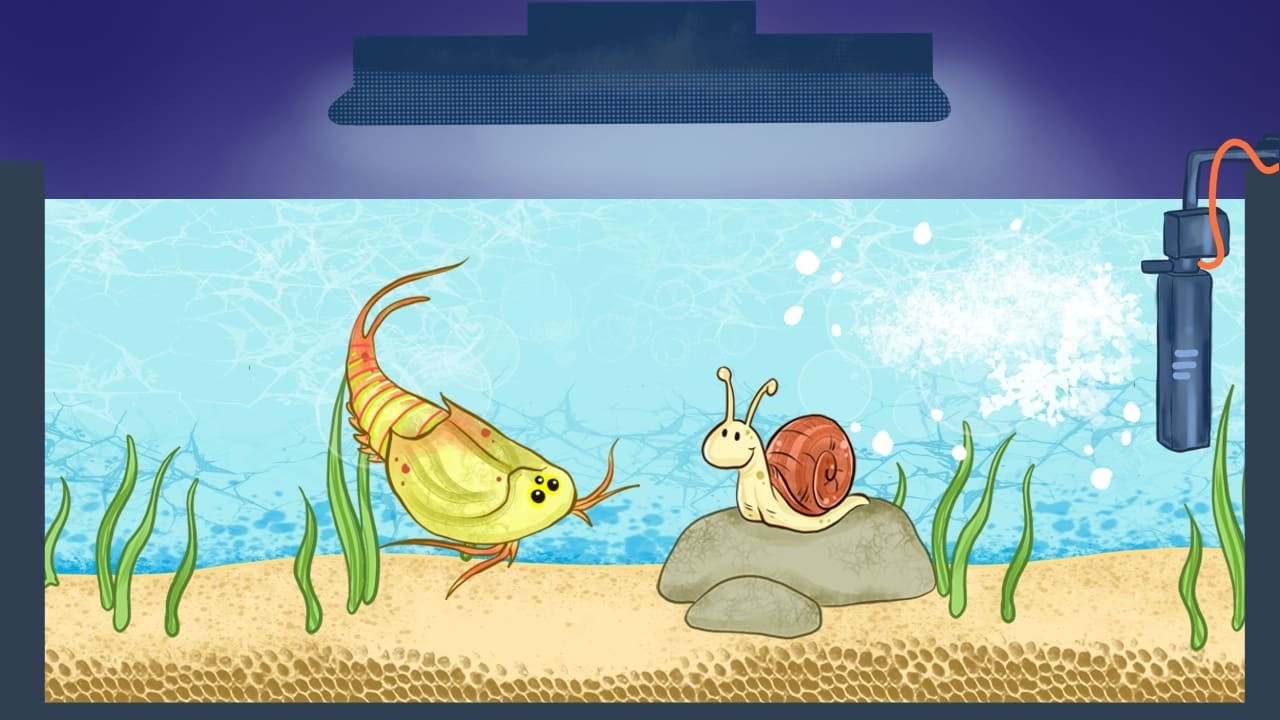
There are three reasons that I am thinking as to why you are curious about how big Triops get. First, you want to know how big Triops get because you want to take care of some. Next, you think your Triops are not growing enough, and lastly, you are scared they will take over our planet if they grow so much. You are just kidding!
The average size of full-grown Triops is 3 inches – 4 inches / 7 cm – 11 cm, depending on some factors. You do not have to worry if your Triops seem small because they are not ample. Look at the table below to see if they are the right size for their age.
They are generally small creatures; they do not grow as big as whales or fishes. And I think that is why it’s still okay to keep them as pets even at this age.
How Big Do Triops Get?
Like any other species, regardless of the type, the growth of Triops is affected by different factors. If you find yourself wondering about the size of your Triops and worrying if something is wrong, look at the table below and assess it according to your Triops.
Below is a table of the standard time frame of growth appropriate for the age of Triops. You can look and see how they are doing in terms of size.
| Stage | Age | Size |
| Eggs | Zero | 270-400 micrometer in diameter |
| Baby Triops | Zero – Two Weeks | less than 0.5 mm at hatching – 0.5 cm long after a few days |
| Adult Triops | Two Weeks – Four Months | 3 inches – 4 inches / 7 cm – 11 cm |
Triops do not grow enormously; they are relatively small compared to other aquatic animals or crustaceans. Imagine if they do?
The small size makes them a little bit less hard to look after. It isn’t complicated; you wouldn’t worry about having to transfer your pets to more giant tanks in the long run unless they grow in numbers.
What are the factors that affect their growth?
Since you know Triops’s standard growth time frame, you must know the factors that affect their growth. What do you need to do if you think they are not growing according to how they should be?
Species
It is the only factor that affects their growth that you have no control over ( unless you intentionally buy a species that is a little bigger than others.)
Some species may grow a little more or less than others. It depends, but the standard revolves around three to four inches. For example, the Triops cancriformis can increase 11 cm long. In captivity, they commonly grow up to 6 centimeters (2.4 in); in the wild, they can achieve sizes of 11 cm (4.3 in).
Here are five of the many species and the sizes they can achieve to the maximum, captivity and wild.
| Type of Specie | Maximum Possible Size |
| Triops Australiensis | 7 cm |
| Triops Cancriformis | 11 cm |
| Triops Granarius | 6 cm |
| Triops Longicaudatus | 7.26 cm |
| Triops Gardensis | 7 cm |
See how their sizes do not have huge differences, but the type of species affects the growth. Some are a little bit bigger than others, and some are smaller.
So it’s a mix of not controlled and controlled factors. You can’t control the species factor, but for the rest, you can surely do something about them.
You can assess how you take care of your Triops in the succeeding factors. And in this case, you might know what you are doing wrong that compromises the growth of your Triops. Evaluate yourself and how you care for them as you read further to understand what you are doing wrong and how you can fix it. These factors are the ones you have control over!
Food intake
Another growth factor is food intake. It hugely influences the growth of your pets. Like any living organism on this planet, your pets need to eat. Two days after the egg hatched, you can feed the baby Triops once a day. On the eighth day, you can start feeding them twice daily and see and estimate the perfect amount of food to give them. Triops are not picky eaters, so you will not have trouble providing and feeding them; it will be the least of your problems.
But be careful never to overfeed your Triops or put too much food in the water. It can cause them to die. Be sure to feed them the right amount and at the right time, do not overfeed them but do not starve them. We want growth, not death!
Tank
They need spaces to grow. It would help if you had a tank that should be at least four liters. Each adult Triops need two to four liters of water to swim. It affects their growth. It will not compromise their health, but it will cause them to be smaller than they should be.
For example, if you put a Triops Australiensis, a species that can grow up to 7cm in length, in a tank with other Triops, surely it will not reach its maximum growth. It will not necessarily die immediately, but it will immensely affect their size.
Regarding the water in the tank, you’ll have to estimate how much to feed based on how frequently you can provide them and how much uneaten food remains after a few hours. You don’t want uneaten food piling up and rotting in the tank, but you also don’t want to starve them. Putting this step into practice helps maintain the tank’s cleanliness and keeps them healthy.
They need space to grow, and the fact that they are inside a tank is already restricting their growth. The least you could do as a Triops owner is to ensure they have the right amount of space and water around them.
Nutrition
As I said earlier, Triops are not picky eaters. But it doesn’t mean that you should feed them whatever. Though they eat a wide variety of food, make sure you give them nutritious ones. It should be high in protein and iodine especially. Usually, the Triops package you buy comes with food pellets for them; those are perfect for nutrition.
Give Triops 1 teaspoon (6 g) of protein in the form of insect larvae, brine shrimp, or fish to grow larger. It would be best if you fed it to them twice a week. Make sure to cut the food into the smallest pieces possible so the Triops can digest it easily.
This part may be difficult because it depends on the Triops kit you purchase. Recognize that newly hatched Triops do not require a lot of food. The all-in-one packet with sand and dried plant clippings is one option. You may not have to feed your pets for the first few days when you purchase your package. The dried plant clippings will already serve as food for the Triops during their growing stage.
Continue feeding your Triops with small amounts of food until they are a few millimeters big. When you see your pets grow, it is time to make them eat more, and with more variation.
You can also feed your Triops the following:
- Triops food
- Fish food
- Catfish food
- Earthworms
- Bloodworms
- Daphnia
- Brine Shrimp
Any of these Triop’s food will help in their growth. These foods will serve the nutrition they require to grow and reach their maximum size.
Regardless of their species, they deserve the proper nutrition and a good amount of growing space. When you want to take care of them, you should be ready to take them as your responsibility. Since their lifespan is short and they are small, you as the owner should do your best to help them live their life to the fullest.
Believe me when I say they will eat anything you put in the water for them. Your pets have big appetites; they even eat their kind if no food is available, especially in captivity. But when you feed them, ensure that you think about their nutrition. Because if you don’t, you will compromise your pets’ growth.
Related Questions
1. Can I grow multiple Triops at the same time?
Yes, you can! But make sure you consider the amount of water and the tank size appropriate for every them. So you do not compromise their size and the number of eggs they lay. Remember, each adult Triops need two to four liters of water to swim.
2. Is there any way to grow them more than the expected size?
Unfortunately, no. It is how your pets are in terms of size; even their specie-type does not have a humongous difference in size. You might think about overfeeding them to grow them even more in size, but in the long run, it will only cause them to die.
Conclusion
Triops are not giant creatures; they are small compared to many sea animals. But that is okay; even though they are small and have a short life span, they are the ones who carry history. Let me remind you that this type of animal has existed for more than a hundred years!